
Pass the credit card fee to the card, the regulated way.
A surcharge adds the cost of credit card acceptance to credit sales only. Washington allows it, with rules. You post a disclosure. Network caps apply. Never on debit. We set all of it up, so you do not have to think about it.
Get a free statement reviewHow this actually works
Surcharging works differently from dual pricing, and the difference matters. You keep one posted price. A customer pays with a credit card. A disclosed percentage is then added to the sale, to cover the cost of credit acceptance. Debit cards, cash and checks pay the posted price with nothing added. The card networks prohibit surcharging debit, full stop. Our guide to lower card processing fees explains where this fits among the other options.
The rules are specific and worth getting right. The surcharge can't exceed the network cap. It can't exceed your actual cost of acceptance either. Disclosure has to be posted at the entrance and at the point of sale. The amount has to appear on the receipt. Run right, it is a standard, accepted practice, especially in B2B. Run sloppy, it brings chargebacks and customer complaints. Review the Washington surcharge rules before you choose a setup. Our brokers handle the caps, signage and receipt format on day one.
A surcharge is not a convenience fee, and the two get mixed up constantly. A convenience fee is a flat charge for paying through an alternative channel the business offers, such as paying an invoice online instead of in person, and it follows much narrower rules. A surcharge is a percentage added to a credit card sale at the ordinary point of sale. Dual pricing is different again: two prices are posted before the sale, a cash price and a card price, and the customer chooses. Which one you are allowed to use depends on which of those three you are actually doing.
The catch: surcharging only moves credit card cost. If half your volume is debit, half your fee problem stays. That is why the first thing we check is your card mix. It is also why we tell you plainly when dual pricing fits you better. For invoice-heavy and B2B businesses, where credit cards rule, surcharging is often the cleanest answer. A free statement review starts with your real mix.
What it takes to switch it on
Five things are true of every surcharge setup we install. We make all five true on day one; you keep running your counter.
The surcharge applies to credit cards. Never to debit, cash or checks. The terminal tells them apart by itself.
A posted notice at the entrance and at the register, before the customer pays. We supply the signage.
The surcharge prints as its own labeled line with the exact amount. No mystery fees, no rounding games.
Visa, Mastercard, Discover and Amex set the caps and the rules. The surcharge is the same on every credit brand you accept. Your terminal enforces it on its own.
Your policy, your disclosure and your rate, all kept on file. If anyone asks, the paperwork is already there.
Five steps to switching it on
This is everything the rules require. You do none of it manually; we and the terminal handle all five.
Register
We notify Visa, Mastercard and Discover that you're adding a surcharge before it goes live. We file it; nothing lands on your desk.
Notify
Signs at the door and at the point of sale tell customers about the surcharge. They see it before they pay.
Apply
The terminal adds the disclosed percent to credit sales only. Never more than the network cap. Never on debit.
Display
The receipt shows the surcharge on its own line, with the amount. That is exactly what the rules require.
Record
Your policy and your disclosures stay on file and up to date. If a card brand reviews you, it is a non-event.
A B2B month, in dollars
This uses a typical rate and card mix as an example. Debit cannot be surcharged, so its cost stays with you. That is the trade. The free statement review puts a number on it with your real mix, before we suggest this over dual pricing.
Getting set up
We check your card mix
Surcharging only applies to credit. If a lot of your volume is debit, we will say so straight. We usually point you to dual pricing instead.
We set the disclosure and the cap
We set up the required signs, the receipt wording and the network cap. It all goes on your free terminal.
Credit fees stop being yours
Credit customers cover the credit cost. Debit runs as it always did. Your statement shrinks.
What it looks like in the wild
No lawyer required. This is the sign on the door and the line on the receipt, done correctly.
We apply a 3% surcharge on credit card purchases. This surcharge does not exceed our cost of acceptance.
Debit and prepaid cards, cash and checks are never surcharged, even when a debit card is run as credit.
Posted at the entrance and the register. We print and ship it with your terminal.
Subtotal                 $100.00
Credit surcharge (3%)      $3.00
Total                    $103.00
The surcharge is its own labeled line, every time. Debit and cash receipts never show one. Where sales tax applies, it is worked out on the price including the surcharge. Full receipt below.
We show 3% here to match the example rate on this page. The terminal enforces the real cap that is set on it.
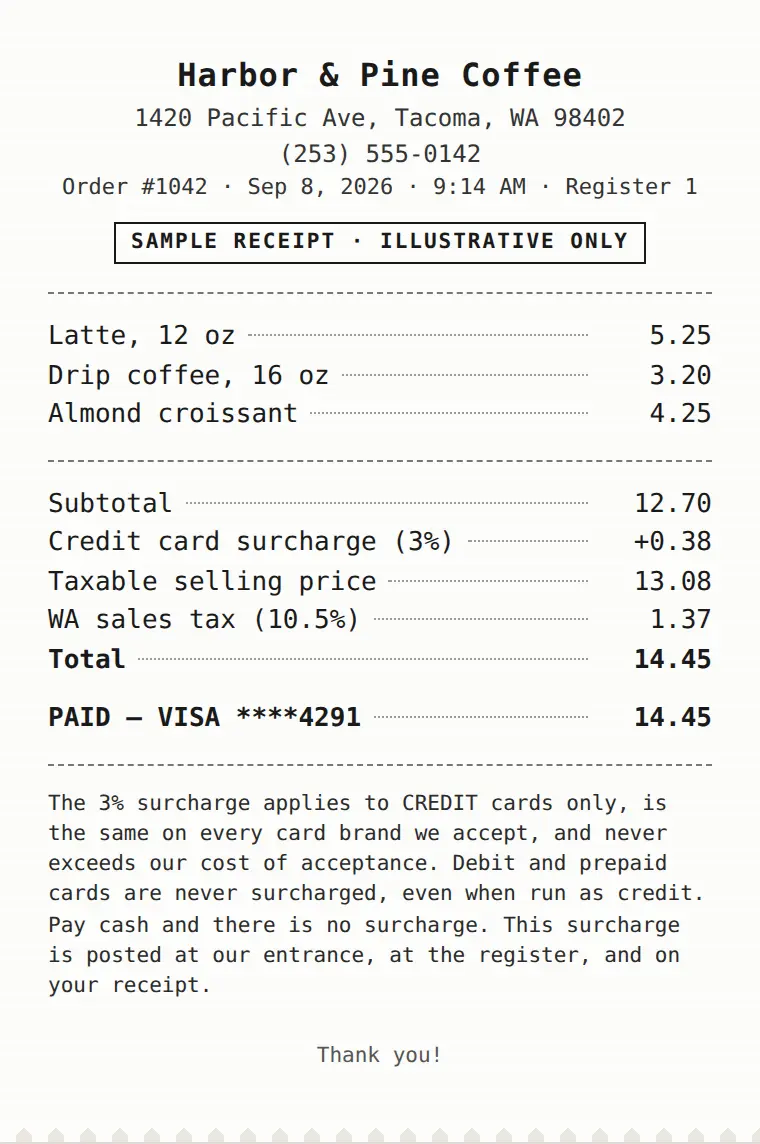
A full surcharge receipt, line by line
A sample receipt from a fictional Tacoma coffee shop, with real Washington tax rules applied.
- The surcharge is added to the subtotal before sales tax. Washington treats a surcharge as part of the selling price, so it is taxed.
- Sales tax is 10.5%, the real rate at the Tacoma address shown.
- It applies to credit cards only. Debit and prepaid cards are never surcharged, even when a debit card is run as credit.
- The receipt names all three places the surcharge is disclosed: the entrance, the register and the receipt itself.
The same order comes to $14.03 in cash and $14.45 by card under dual pricing and a cash discount too. Only the way the register shows it changes.
Surcharging is the right tool for the right mix. When your volume is mostly credit, it quietly removes the biggest line on your statement while keeping one posted price. When your mix is debit-heavy, we'll say so and point you to dual pricing instead. Knowing the difference is what you have a broker for. We set this up for credit-heavy shops across the region, including Bellevue and the Eastside.
Every business we set this up for could have stayed put. Read why they switched →
- B2B and invoice-heavy shops where credit cards rule
- Firms with big tickets, like law, accounting or consulting
- Owners who prefer one posted price with a disclosed credit surcharge
The three models, side by side
NWPB offers three ways to handle card fees. The free statement review tells you which one wins with your real numbers.
Dual pricing
Cash price and card price posted side by side. The customer picks, you keep 100%.
Best when most sales happen at a counter or table. You want the fees gone for good.
Surcharging
The card cost is added to credit card sales only. You post a notice, and a cap applies.
Best when most of your sales are on credit cards. Think B2B and professional services.
Interchange plus
You absorb the fees, but pay true wholesale cost plus one small visible markup.
Best when you want one posted price. You still pay the fee, but you pay as little as you can.
Where surcharging wins
The pattern is simple: big tickets, paid by credit. If that sounds like your ledger, this program was built for you.
Contractors and trades
Five-figure invoices paid by business credit card. The 3% on a $20,000 job is real money, and now it's not yours.
Professional services
Law, accounting, consulting. Clients pay by card for the points and accept the disclosed cost without blinking.
B2B and wholesale
Surcharging is standard practice between businesses. Many buyers just switch to ACH, which cuts what it costs you by two-thirds or more.
Medical, dental and veterinary
A high average ticket and card-heavy sales make the math work fast.
Auto repair
An $800 average ticket on a credit card is $24 you were absorbing. Multiply by a month of cars.
Most retail counters and restaurants run debit-heavy. Debit cannot be surcharged. So that mix favors dual pricing. We will tell you so before you install a thing.
Invoice-heavy? Put the pay button on the invoice
Most businesses that surcharge bill by invoice. Hyfin sends invoices by email or text with a pay button, chases the unpaid ones automatically, and 85% get paid within a day. Your card-fee program applies there too.
Fair questions
What is a credit card surcharge?
It is a fee a business adds to a credit card sale to cover the cost of accepting that card. The customer who pays by credit card covers the credit card cost. Anyone paying by debit, cash or check pays the posted price with nothing added. It is credit-only, capped at your actual cost of acceptance, and it has to be disclosed before payment and itemized on the receipt.
Is a credit card surcharge the same as a convenience fee?
No. A convenience fee is a flat charge for paying through an alternative channel, like paying an invoice online instead of in person, and it follows its own narrow rules. A surcharge is a percentage added to a credit card sale at the normal point of sale. They are different tools with different rule sets.
Who can help me set up a credit card surcharge program in Washington state?
Northwest Payment Brokers. We are a local Seattle-Tacoma merchant services broker and we set up credit card surcharge programs for Washington businesses. We handle the network registration, the cap, the required signage, and the receipt line, so it is compliant on day one. Send one recent statement and the statement review is free.
Can you surcharge a credit card in Washington?
Yes, with conditions. You post a clear disclosure. The rate is capped. It applies to credit cards only. We set up all three correctly.
Why can't I surcharge debit cards?
Network rules prohibit surcharges on debit and prepaid cards. That holds even when the customer runs them as credit. So your card mix decides whether this program or dual pricing wins.
What's the maximum surcharge?
It is the lower of two limits: your actual cost of accepting credit, or the card network cap. Visa caps it at 3% and Mastercard at 4%, but a business that takes Visa is held to 3% on every brand, because the surcharge has to be the same across the credit cards you accept. We set that ceiling on the terminal, so the register can’t get it wrong.
Will B2B customers accept it?
Surcharging is common and expected in B2B. Most business customers pay by card for the points and accept the disclosed cost, or switch to ACH, which cuts what it costs you by two-thirds or more. Either way you win.
What shows up on the customer's receipt?
The surcharge shows up as its own disclosed line, with the amount, just as the rules require. No mystery fees. No rounding games.
Surcharge or dual pricing, which is right for me?
Mostly credit volume favors a surcharge. Mixed or debit-heavy volume favors dual pricing. The free statement review tells you which one fits. It runs on your real numbers, not a guess.
What does setup cost?
Nothing. Free terminal, free signs, free setup. No long contract.