
Looking for a cash discount program? It has a better name now.
What merchants call a cash discount is run today as dual pricing. Your cash price and card price sit side by side. The customer picks. You keep 100% of every sale. Same outcome you searched for, done the way the card brands accept.
Get a free statement reviewHow this actually works
Here is a quick history, because the terms get confusing. The first cash discount idea was simple. Post one price, then take a discount off it for cash payers. Over time, a lot of providers flipped that around. They posted one price and added a fee for cards at the register. Customers hated the surprise. The card brands started flagging programs set up that way. See dual pricing vs cash discount vs surcharge for how the three actually compare, or our guide to lower card processing fees for how this fits with the other fee programs. To see what Washington businesses pay today, read our page on payment processing fees.
Dual pricing is the cleaned-up version of the same goal. There is no one price plus a surprise. Every item shows both prices before the sale, cash and card. The customer chooses, and knows both numbers. The terminal picks the right price by itself. The receipt matches what was posted. You wanted one thing from a cash discount. You wanted the card fee off your side of the ledger. That is exactly what you get.
If you already run a cash discount program, this page matters double. A setup that adds a percentage at the register can get flagged. That is the kind that does not post two prices. The fix costs nothing. We set it up again as true dual pricing. What your customers pay stays the same; the signage and receipts change to post two clear prices, the way the rules require. See what dual pricing actually saves Washington businesses across real statements, or start with a free statement review for a clear starting point.
Same savings, cleaner setup
This uses a typical effective rate as an example. A small monthly program cost stays. What goes away is the cut taken out of every sale. Your free statement review uses your real numbers.
Getting set up
We review what you have
If you're already on a cash discount program, we check the setup. A lot of them are configured in ways the card brands flag.
We move you to dual pricing
Both prices posted up front. Customers see it before they order, not on the receipt.
You keep the outcome
The fee comes off your statement either way. That part doesn't change.
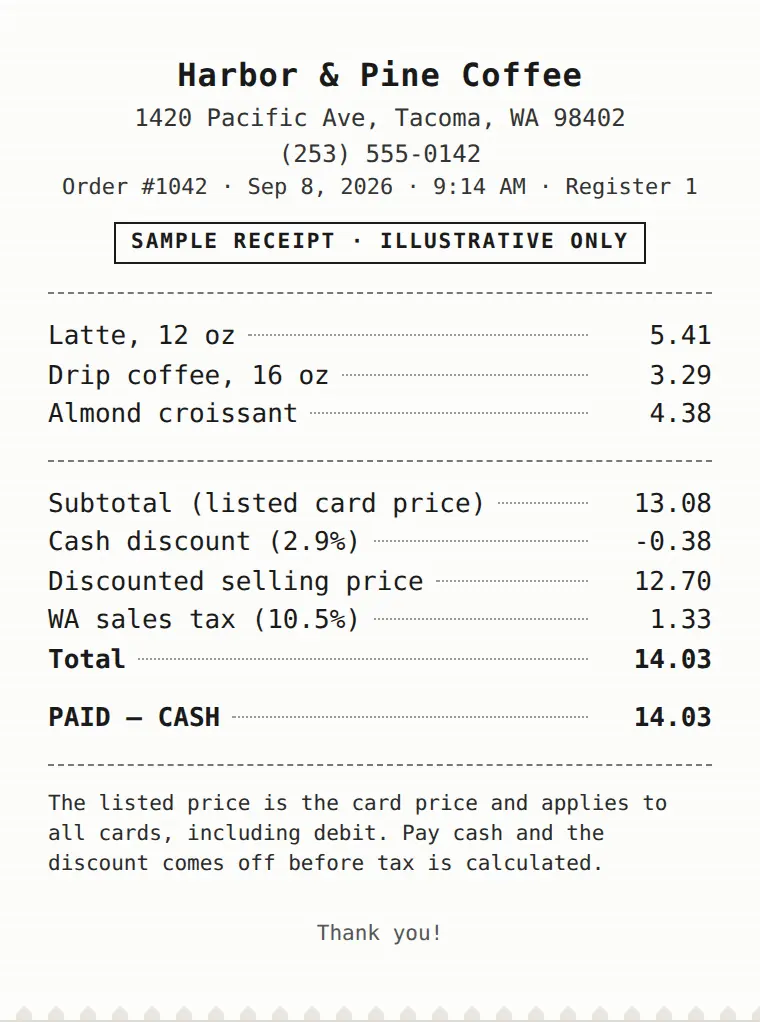
What a real cash discount receipt looks like
If you run a cash discount, the receipt should read like this. A sample from a fictional Tacoma coffee shop, with real Washington tax rules applied.
- The listed price is the card price. Nothing is added for paying by card.
- Pay cash and the discount comes off before sales tax is worked out, so tax is charged on the lower price.
- The card price applies to every card, debit included.
- A register that adds a percentage for cards instead is running a surcharge, and the surcharge rules apply.
2.9% off $13.08 is the same $0.38 as a 3% surcharge on $12.70. The customer pays $14.03 in cash or $14.45 by card either way.
If you found this page searching for a cash discount, you want the right thing: stop eating card fees. Our job is making sure you get it the durable way. Two posted prices, compliant signage, correct receipts. Same savings, zero flags, and we do the conversion free.
Every business we set this up for could have stayed put. Read why they switched →
- Owners who heard about cash discount from a shop down the street
- Owners on a cash discount who want it set up right
- Restaurants, shops and service firms doing $20K+ a month
The three models, side by side
NWPB offers three ways to handle card fees. The free statement review tells you which one wins with your real numbers.
Dual pricing
Cash price and card price posted side by side. The customer picks, you keep 100%.
Best when most sales happen at a counter or table. You want the fees gone for good.
Surcharging
The card cost is added to credit card sales only. You post a notice, and a cap applies.
Best when most of your sales are on credit cards. Think B2B and professional services.
Interchange plus
You absorb the fees, but pay true wholesale cost plus one small visible markup.
Best when you want one posted price. You still pay the fee, but you pay as little as you can.
Fair questions
Is cash discount the same as dual pricing?
The goal is the same. Card fees stop being yours. Dual pricing is the version where both prices are posted before the sale. That is what the card brands accept, and what we install.
I already run a cash discount. Why change anything?
Maybe it is set up as a fee added at the register, not as two posted prices. That kind can get flagged. Some processors quietly charge you for the risk. We fix the structure without changing your savings.
Will my regulars notice a change?
They will see two posted prices. They will not see a change made at the register. That lands better, because nobody feels ambushed by the receipt.
What does switching cost?
Nothing. Free terminal, free signs, free setup. No long contract.
Do my prices have to go up?
Your cash price stays your price. The card price covers the card cost. Customers choose.
Is this allowed in Washington?
Yes. Posting two prices before the sale is the structure that works everywhere. We handle the disclosure details. You never have to think about them.
How long does the conversion take?
Usually under a week. That includes new signs and a staff walkthrough. Most of it happens without cutting into your business day.